
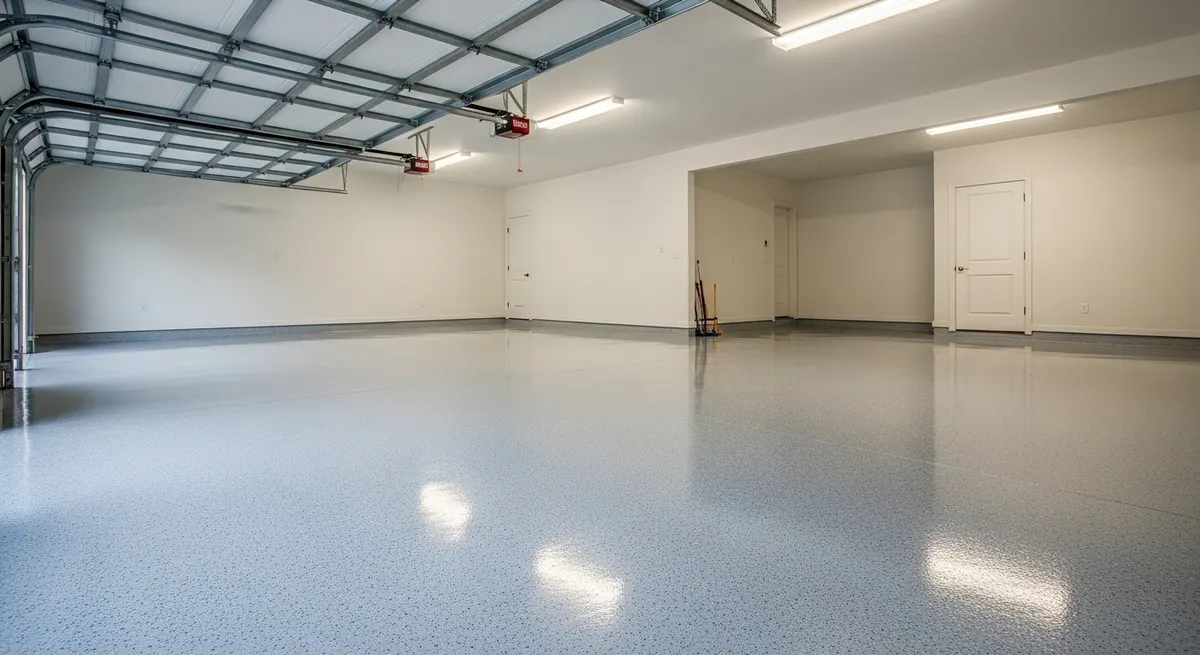
Quick Answer
Professional epoxy flooring costs roughly $3 to $12 per square foot installed, and a two-car garage typically runs $1,500 to $5,000. Epoxy is a two-part resin-and-hardener coating that chemically cures into a seamless, ultra-durable surface bonded to concrete. Done right over diamond-ground, moisture-tested concrete, a professional floor lasts 10 to 20 years.
Key Takeaways
- Professional epoxy flooring costs $3-$12 per square foot installed; a two-car garage typically runs $1,500-$5,000.
- A pro-installed floor lasts 10-20 years residentially; surface prep is the number-one factor in durability.
- Diamond grinding and moisture testing of the concrete are non-negotiable; skipping them causes peeling and bubbling.
- Flake and metallic systems add custom looks and slip resistance; polyaspartic topcoats add UV stability and faster cure.
- Most epoxy failures come from poor prep or moisture, which is why professional installation far outlasts cheap DIY kits.
What Is Epoxy Flooring?
Epoxy flooring is a high-performance surface created by applying a thermosetting resin coating over a concrete slab. Epoxy is a two-part system: a resin and a hardener that, when mixed, chemically react and cure into a rigid, plastic-like material that bonds tightly to the concrete below. The result is a seamless, durable, and attractive floor that is dramatically tougher and easier to maintain than bare or painted concrete. Because the coating becomes a permanent part of the slab, it stands up to the kind of abuse — vehicle tires, dropped tools, chemical spills, and constant foot traffic — that would quickly destroy a painted surface.
Although people often say "epoxy paint," true epoxy flooring is not paint. Paint dries by evaporation and sits on the surface; epoxy cures through a chemical reaction and forms a thick, bonded layer that becomes part of the floor system. This distinction is the key to understanding why a properly installed epoxy floor can withstand decades of heavy use while a painted concrete floor chips and wears within a year or two. The chemistry also explains why installation is unforgiving: mixing ratios, temperature, humidity, and timing all influence whether the coating cures into a tough, glassy film or a soft, tacky failure.
Epoxy flooring sits within a broader family of resinous floor coatings that includes polyurethane, polyaspartic, polyurea, and acrylic systems. In practice, the highest-performing residential and commercial floors are often hybrids — an epoxy base coat chosen for its adhesion and build, finished with a polyaspartic or polyurethane topcoat chosen for its UV stability and abrasion resistance. Understanding these layers and how they work together is the foundation for choosing the right system and getting an accurate quote.
Prepare a clear scope using our quote comparison checklist. Confirm service area, credentials and availability directly with any contractor. Directory listings are being restored.
What a complete epoxy floor system includes
- Concrete preparation — grinding or shot blasting, crack and joint repair, and moisture testing.
- Primer / base coat — penetrates and bonds to the prepared concrete and seals the surface.
- Build / color or decorative layer — solid color, flake broadcast, quartz, or metallic effect.
- Topcoat / clear coat — the protective wear layer that seals the floor and provides sheen and slip resistance.
The Benefits of Epoxy Flooring
Epoxy's popularity in garages, basements, showrooms, and industrial facilities comes down to a rare combination of toughness, low maintenance, and good looks at a reasonable price. Few surfaces deliver this much performance per dollar, and once installed, an epoxy floor essentially eliminates the dusting, staining, and cracking that plague bare concrete.
Exceptional durability
A quality epoxy floor resists impact, abrasion, and heavy loads, standing up to vehicles, equipment, and dropped tools. It does not chip and wear the way painted concrete does, which is why it is the default choice for warehouses, auto shops, and aircraft hangars. High-build systems can carry forklift traffic and point loads from racking without cracking, and the seamless film prevents the surface dusting that bare concrete sheds over time.
Chemical and stain resistance
Epoxy resists oil, gasoline, brake fluid, antifreeze, household chemicals, and de-icing salts. Spills wipe up rather than soaking into porous concrete, making it ideal for garages, workspaces, and any place where stains are inevitable. In commercial kitchens and food-processing facilities, this same impermeability keeps the floor sanitary and prevents bacteria from colonizing pores and grout lines.
Easy to clean
The seamless, non-porous surface has no grout lines or pores for dirt and bacteria to hide in. A dust mop and occasional damp mop keep it looking new, a major advantage in both homes and commercial settings. Because the floor does not absorb liquids, even stubborn spills sit on the surface until they are wiped away rather than leaving a permanent mark.
Brighter, safer spaces
Glossy epoxy reflects light, often increasing ambient brightness in a garage or basement significantly and reducing the need for added lighting. This light reflection is more than cosmetic: better visibility improves safety in work areas, and slip-resistant additives plus safety-color line striping help organize traffic and mark hazards in commercial environments.
Attractive and customizable
From clean solid colors to decorative flake and dramatic metallic effects, epoxy offers design flexibility that transforms a utilitarian slab into a showroom-quality floor. The same coating that protects a warehouse can be tinted, flaked, or marbled to create a finished living space, which is why epoxy increasingly appears in basements, home gyms, and finished garages, not just industrial plants.
Strong return on investment
Because a professional floor lasts 10 to 20 years, the cost spread over its service life is very low compared with repainting concrete every couple of years. A finished, coated garage or basement also adds usable, attractive square footage that buyers notice, making epoxy one of the better value-adding upgrades for the money. Many homeowners coat the garage at the same time they handle exterior work like pressure washing and exterior painting to refresh the whole property at once.
Sanitary, low-static, and seamless
Beyond looks and toughness, epoxy delivers performance benefits that matter in specialized settings. The seamless, non-porous film leaves no grout lines or pores for bacteria, mold, or allergens to colonize, which is why it is specified for hospitals, labs, and food-processing plants where surfaces must be wiped down and sanitized. Specialized ESD (electrostatic-dissipative) and conductive epoxy systems control static buildup to protect sensitive electronics and reduce ignition risk in areas handling flammable materials. The continuous surface also eliminates the small cracks and joints where concrete normally sheds dust, improving air quality in clean rooms and warehouses alike. Add a coved base where the floor curves up the wall, and the entire room becomes a single washable, hygienic surface — a level of cleanliness no tile-and-grout floor can match.
Where Epoxy Flooring Is Used
Epoxy works almost anywhere there is a sound concrete slab, but it shines in spaces that demand durability, chemical resistance, and easy cleaning. The right system varies by setting: a residential garage and a commercial kitchen call for very different builds and topcoats.
Residential applications
- Garages — the most common use; durable, oil-resistant, slip-modified, and easy to clean, with flake systems hiding tire marks and minor imperfections.
- Basements — seals porous concrete, brightens the space, resists moisture from above, and creates a clean, finished surface for living areas or storage.
- Workshops and home gyms — tough, impact-resistant, and low-maintenance, standing up to dropped weights, rolling tool chests, and equipment.
- Patios, sunrooms, and entryways — with UV-stable polyaspartic topcoats for appearance, color retention, and grip in areas exposed to sunlight.
- Laundry and utility rooms — waterproof, easy to mop, and resistant to detergents and bleach.
Commercial and industrial applications
- Warehouses and manufacturing — withstand forklifts, pallet jacks, and heavy equipment, often with high-build or mortar systems and safety line striping.
- Auto dealerships and repair shops — chemical resistance for oil and fluids combined with showroom shine.
- Commercial kitchens and food processing — seamless, sanitary, and easy to clean, frequently using quartz systems with integral cove base.
- Retail and showrooms — decorative metallic and flake floors for a premium, distinctive look.
- Hospitals, labs, and cleanrooms — sanitary, chemical-resistant, low-static, and durable.
For larger facilities, epoxy is often part of a broader maintenance program handled alongside commercial painting, since the same contractors that coat walls and ceilings frequently install resinous floors. Whatever the setting, the unifying requirement is the same: a clean, sound, properly profiled slab.
Where epoxy is not the right choice
Epoxy is versatile, but it is not a universal answer. It bonds to concrete, not to wood subfloors, vinyl, or existing tile, so it is not a drop-in upgrade for a typical above-grade living space. It also requires a structurally sound slab: a floor with active settling, heaving, or recurring cracks will telegraph that movement through the coating no matter how well it is applied. Exterior slabs in freeze-thaw climates need careful product selection and a UV-stable, breathable topcoat, because trapped moisture under a sun-baked coating can cause blistering. And brand-new concrete must cure for roughly 28 days before coating so residual moisture and curing compounds do not interfere with adhesion. A reputable installer will flag these conditions during the site visit rather than coat a slab that is destined to fail.
Coating Systems and Types of Epoxy
"Epoxy flooring" covers several distinct systems and resin chemistries, each suited to different budgets, looks, and performance needs. Understanding the categories helps you compare quotes accurately, because a $3-per-square-foot water-based coating and a $12-per-square-foot high-solids hybrid are very different products even if both are called "epoxy."
100% solids vs. water-based vs. solvent-based epoxy
The first distinction is the resin's solids content. 100% solids epoxy contains no water or solvent carrier, so essentially everything applied stays on the floor as a thick, durable film, typically 10 to 20 mils or more per coat. It is the gold standard for garages and commercial floors but cures fast and requires experience to install. Water-based epoxy is thinner, lower in odor, more forgiving to apply, and far cheaper, but it leaves a much thinner film (often 2 to 4 mils) and wears out faster; most big-box DIY kits are water-based. Solvent-based epoxy penetrates well and performs in cooler conditions but carries higher VOCs and stronger fumes, so it has largely been replaced by 100% solids products in occupied spaces.
Solid color epoxy
A clean, single-color coating, often with an optional anti-slip additive. It is the most economical professional system and a popular choice for garages and utility spaces where appearance is secondary to a durable, easy-clean surface. Solid color floors show dust and tire marks more readily than flake, which is why many homeowners step up to a chip system.
Flake (chip) systems
Decorative vinyl flakes are broadcast into a base coat and sealed with a clear topcoat. Flake systems hide imperfections, add natural slip resistance and texture, and offer endless color blends — making them the most popular residential garage option. Flakes are broadcast either to a light "accent" coverage or fully "to refusal," where the floor is saturated and excess is scraped off for a uniform, terrazzo-like look.
Metallic epoxy
Metallic pigments are manipulated with solvents, torches, and rollers to create flowing, three-dimensional effects resembling marble, lava, or water. Stunning in showrooms, basements, and retail, these premium floors require skilled application and are never identical twice, which is part of their appeal as a high-end feature surface.
Self-leveling epoxy
A thicker pour that flows out and smooths over minor imperfections to create a perfectly flat, seamless surface. Common in commercial and industrial settings, self-leveling systems are also used to correct slabs that are slightly uneven before a decorative finish is applied.
Mortar and quartz systems
Heavy-duty systems blend epoxy with sand or colored quartz aggregate for maximum impact and abrasion resistance. Quartz systems deliver a decorative, slip-resistant, sanitary surface ideal for commercial kitchens, locker rooms, and healthcare, while epoxy mortar is used in industrial plants and loading docks that take the harshest abuse.
Polyaspartic and hybrid systems
Polyaspartic, a fast-curing polyurea, resists UV yellowing and abrasion and can be applied across a wide temperature range. Many premium installs use an epoxy base for adhesion and build, topped with a polyaspartic clear coat for a faster, tougher, UV-stable finish — sometimes completed in a single day. Because polyaspartic does not amber in sunlight, it is the preferred topcoat anywhere the floor sees natural light.
| System | Film Build | UV Stability | Best For |
|---|---|---|---|
| Water-based epoxy | Thin (2-4 mils) | Low | Budget / DIY, light use |
| 100% solids epoxy | Thick (10-20+ mils) | Low-moderate | Garages, commercial base coat |
| Polyaspartic | Moderate | High | Topcoats, fast-cure, sunlit areas |
| Quartz / mortar | Very thick | Varies by topcoat | Industrial, kitchens, heavy abuse |
| Metallic epoxy | Moderate | Needs UV topcoat | Showrooms, feature floors |
How Much Does Epoxy Flooring Cost?
Professional epoxy flooring generally costs $3 to $12 per square foot installed, with high-end decorative and industrial systems running higher. Price is driven primarily by the system type, the condition of the concrete, and the amount of prep required. A simple water-based coating over a clean, newer slab sits at the low end, while a multi-layer flake or metallic system with polyaspartic topcoat over a slab needing repair and moisture mitigation sits at the high end.
| System | Cost per Sq Ft | Best For |
|---|---|---|
| Solid color (basic) | $3 - $7 | Garages, utility spaces |
| Flake / chip system | $5 - $10 | Residential garages, basements |
| Metallic epoxy | $8 - $15 | Showrooms, retail, feature floors |
| Self-leveling | $5 - $12 | Commercial, smoothing slabs |
| Quartz / mortar | $7 - $15+ | Industrial, kitchens, heavy use |
| Two-car garage (total) | $1,500 - $5,000 | 400-500 sq ft installed |
What affects the price
- Concrete condition. Cracks, pitting, oil staining, and old coatings add prep labor and material cost.
- System and layers. More coats, decorative flake or metallic, and polyaspartic topcoats increase price.
- Moisture mitigation. Slabs with high moisture need a mitigating primer, adding cost but preventing failure.
- Thickness. Thicker, higher-build systems cost more but last longer under heavy traffic.
- Size and access. Larger floors lower the per-foot cost; tight, obstructed, or multi-room spaces raise it.
- Region and labor rates. Costs vary significantly by market, mirroring local construction wages.
Prepare a clear scope using our quote comparison checklist. Confirm service area, credentials and availability directly with any contractor. Directory listings are being restored.
Cheap kits are a false economy
The Professional Installation Process
A durable epoxy floor is the product of disciplined preparation and correct application. Knowing the sequence a professional follows helps you evaluate whether an installer is doing the job properly or cutting the corners that lead to failure. The steps below match the structured how-to a quality crew works through on nearly every job.
- Inspection and moisture testing. The installer evaluates the slab's condition and tests for moisture vapor using a calcium chloride or relative humidity test, since untreated moisture can doom a coating from below.
- Concrete profiling. The surface is diamond-ground or shot-blasted to remove coatings, sealers, and contaminants and to create a profile (CSP 2-3 for most coatings) that the epoxy can grip.
- Repairs. Cracks, control joints, spalls, and pits are filled and leveled with appropriate epoxy or polyurea patching compounds, then ground flush.
- Cleaning. All dust and debris are removed with an industrial vacuum so nothing interferes with adhesion of the primer.
- Primer / base coat. A penetrating primer or pigmented base coat is applied to bond to the concrete, with a moisture-mitigating primer where the slab tests high.
- Color or decorative layer. Solid color is applied, flakes are broadcast, or metallic pigments are worked for effect while the base coat is still wet.
- Scrape and clean (flake systems). Excess flake is scraped and vacuumed for a smooth, uniform result before topcoating.
- Topcoat. A clear protective coat — often polyaspartic — is applied, with anti-slip additive incorporated as needed.
- Cure. The floor cures between coats and fully over several days before foot traffic, then vehicle traffic, per the manufacturer's schedule.
Timing matters at every step. Once the resin and hardener are combined, the mixture has a limited pot life, and each coat must go down within a recoat window so the layers chemically bond. This is why experienced crews plan the job carefully, mix in manageable batches, and work efficiently across the slab rather than stopping mid-floor.
Watch the temperature and humidity
Concrete Preparation and Moisture Testing
If there is one thing to understand about epoxy flooring, it is this: preparation determines everything. The best epoxy in the world will peel off a poorly prepared slab, and a modest system will last for years on a properly prepared one. Surface prep is the invisible difference between a floor that lasts twenty years and one that bubbles within months.
Mechanical profiling
Concrete must be mechanically profiled — by diamond grinding or shot blasting — not merely cleaned or acid-etched. Grinding removes the smooth, weak top layer of cement (laitance) along with old sealers and coatings, and opens the surface pores so the epoxy can lock in. Installers describe the result using the Concrete Surface Profile (CSP) scale; most coatings want a CSP of 2 to 3, roughly the texture of medium sandpaper. Skipping mechanical profiling is the single most common reason DIY and bargain installs fail.
Moisture testing and mitigation
Concrete is porous, and moisture vapor can rise through the slab from the soil below, pushing against and delaminating the coating. Professionals perform moisture tests — typically a calcium chloride test that measures vapor emission or in-situ relative humidity probes — before coating. When levels are high, they apply a moisture-mitigating primer or vapor-barrier system before the build coats. Ignoring moisture is a leading cause of bubbling, blistering, and peeling, especially in basements and slabs poured without a vapor barrier.
Crack, joint, and spall repair
Cracks, control joints, pits, and spalled areas are repaired and leveled so the finished floor is smooth and the damage does not telegraph through the coating or spread over time. Static cracks are filled rigidly, while moving control joints may be honored or filled with a semi-rigid filler depending on the system and the slab's behavior.
Cleaning and decontamination
Oil and grease that have soaked into a garage slab must be degreased and, if deeply embedded, ground out, because epoxy will not bond over contamination. After grinding, the entire floor is vacuumed with an industrial HEPA vacuum so no dust remains to compromise adhesion. Because grinding generates respirable crystalline silica dust, reputable crews follow OSHA silica and respiratory-protection guidance, using dust extraction and PPE on every job.
Ask one question to vet any installer
Temperature, Humidity, and Cure Windows
Epoxy is a chemical reaction, not a coat of paint, so environmental conditions during application and cure are every bit as important as surface prep. Get the temperature, humidity, or timing wrong and even a premium product over a perfectly ground slab can stay tacky, blush, bubble, or fail to harden. This is why experienced crews measure slab temperature, air temperature, relative humidity, and dew point before they ever open a kit — and why they sometimes reschedule rather than push a job into bad conditions.
The working temperature range
Most standard 100% solids epoxies want a slab and air temperature between roughly 50°F and 90°F, with the sweet spot around 65°F to 75°F. Below about 55°F, the resin thickens, flows poorly, and can take twice as long to cure or never reach full hardness; below 50°F many products will not chemically cross-link at all. Above 90°F the opposite problem appears — the pot life collapses, sometimes to just a few minutes, and the coating can flash off before it self-levels. Polyaspartic topcoats are far more forgiving and can be installed from roughly 0°F to 100°F, which is one reason they dominate cold-weather and fast-turnaround work.
Humidity and the dew point rule
Relative humidity below about 85% is the usual upper limit, but the number that matters most is the dew point. The slab surface must stay at least 5°F above the dew point throughout application and early cure; otherwise invisible moisture condenses on the concrete and ruins adhesion, leaving a hazy, milky "amine blush" or outright delamination. This is especially common in spring and fall, when a cold slab meets warm, humid air, and in unconditioned garages where the door is left open.
| Stage | Approximate Time | What You Can Do |
|---|---|---|
| Tack-free / recoat window | 6 - 24 hours | Apply the next coat |
| Light foot traffic | 12 - 24 hours | Walk in socks, no grit |
| Normal foot traffic | 24 - 48 hours | Resume walking, place light items |
| Vehicle / heavy loads | 3 - 7 days | Park cars, roll tool chests |
| Full chemical cure | 7 - 30 days | Maximum chemical resistance |
Prepare a clear scope using our quote comparison checklist. Confirm service area, credentials and availability directly with any contractor. Directory listings are being restored.
Finishes and Custom Looks
Epoxy is as much a design choice as a performance one. The decorative options let you match a utilitarian garage or a high-end showroom, and the same durability is available across nearly every look.
- Solid colors — clean, professional, and economical, from classic gray and tan to bold safety colors and tile red.
- Flake blends — multi-color chip systems that hide dirt and imperfections while adding texture and grip; blends are mixed to match decor or brand colors.
- Metallic effects — dramatic, marbled, three-dimensional finishes unique to every pour, ideal for feature floors.
- Quartz — colored quartz aggregate for a textured, heavy-duty, decorative, and sanitary surface.
- Sheen options — high-gloss for maximum shine and light reflection, satin for a softer look, or matte for a contemporary, low-glare finish.
Slip resistance
Any finish can be made slip-resistant by adding fine aggregate — silica, aluminum oxide, or polymer grit — to the topcoat. This is strongly recommended for garages, ramps, kitchens, entryways, and any area that gets wet. The amount and grade of aggregate can be tuned: a fine additive adds traction without changing the look much, while a coarser broadcast creates a more aggressive, cleanable texture for wet commercial floors.
Color stability and UV exposure
Standard epoxy ambers, or yellows, when exposed to ultraviolet light, so any floor that sees sunlight — through garage doors, windows, or skylights — should be topped with a UV-stable polyaspartic or polyurethane clear coat. This keeps whites and grays looking true and prevents the patchy discoloration that plagues uncoated or epoxy-topcoated floors in sunlit spaces.
Decorative Options Deep Dive: Flake, Metallic, and Quartz
Once you have settled on a durable system, the decorative layer is what most homeowners and facility managers actually choose between. The three most popular finishes — flake, metallic, and quartz — look very different, install differently, and carry different price tags. Knowing how each is built helps you read a quote, anticipate the look, and pick the right finish for the way the room is used.
Flake (chip) systems
Flake systems broadcast colored vinyl chips into a wet base coat, then seal them under a clear topcoat. Chips come in sizes from about 1/16 inch up to 1 inch; smaller chips read as a fine, speckled stone, while larger chips give a bolder, terrazzo-like pattern. Coverage is the key variable: a light "accent" broadcast leaves base color showing for a budget look, while a full broadcast "to refusal" saturates the floor so no base color peeks through and excess is scraped away. Full broadcast costs more in material and labor but hides imperfections, tire marks, and future patches far better, and the embedded chips add natural slip texture that makes flake the default for residential garages.
Metallic epoxy
Metallic floors blend mica-based pigments into a clear or tinted resin, then manipulate them with rollers, squeegees, solvent spritzing, and sometimes heat to create flowing, three-dimensional patterns that mimic marble, lava, or rippling water. No two metallic pours are identical, which is the appeal — and the risk, since results depend heavily on installer skill. Metallic systems almost always need a UV-stable polyaspartic or polyurethane topcoat, and because they tend to be smooth and glossy, an anti-slip additive is strongly advised for any area that gets wet. They suit showrooms, basements, and retail far better than working garages.
Quartz systems
Quartz systems broadcast colored, kiln-dried quartz aggregate into the resin, building a thick, troweled or double-broadcast floor that is extremely impact- and abrasion-resistant. The texture is naturally slip-resistant and sanitary, which is why quartz dominates commercial kitchens, locker rooms, healthcare suites, and stairwells, often paired with an integral cove base where the floor curves up the wall for easy sanitation.
| Finish | Cost per Sq Ft | Texture | Best Fit |
|---|---|---|---|
| Accent flake | $4 - $7 | Light, subtle grip | Budget garages |
| Full broadcast flake | $6 - $10 | Pronounced, grippy | Garages, basements |
| Metallic | $8 - $15 | Smooth (add grit) | Showrooms, feature floors |
| Single-broadcast quartz | $7 - $12 | Textured | Kitchens, light commercial |
| Double-broadcast quartz | $10 - $18+ | Heavy, very durable | Industrial, healthcare |
When comparing decorative quotes, confirm the chip size and broadcast rate for flake, the topcoat type for metallic, and the number of aggregate broadcasts for quartz. If you are coordinating the look with adjacent finished rooms, our interior painting guide covers matching wall colors to a new floor.
Epoxy vs. Alternatives
Epoxy is one of several ways to upgrade concrete. Here is how it compares to the most common alternatives so you can decide whether it is the right choice for your space.
| Option | Durability | Cost | Notes |
|---|---|---|---|
| Concrete paint | Low (1-3 yrs) | $ | Cheap, chips and wears fast |
| Epoxy coating | High (10-20 yrs) | $ | Tough, customizable, best value |
| Polyaspartic | Very high | $$ | Fast cure, UV-stable, premium |
| Polished concrete | High | $ | No coating; grinding & sealing |
| Tile / pavers | High | $$ | Grout lines, harder to maintain |
| Interlocking PVC tiles | Moderate | $ | DIY, removable, seams collect dirt |
For most garages, basements, and commercial spaces, a professional epoxy or epoxy-polyaspartic hybrid offers the best balance of durability, appearance, and value. Concrete paint is cheaper upfront but a poor long-term investment, while tile and pavers cost more and introduce grout lines that complicate cleaning. Polished concrete is an excellent coating-free option where you want the raw industrial look and are willing to accept that it offers less stain resistance than a sealed resinous system.
The right answer depends on use. A homeowner who wants a bright, easy-care garage that resists oil and road salt is well served by a flake epoxy floor with a polyaspartic topcoat. A warehouse taking forklift traffic needs a high-build or mortar system. A retail showroom may prioritize a metallic feature floor. Matching the system to the demands of the space is exactly the kind of judgment a qualified installer brings.
DIY Kits vs. Hiring a Professional
Epoxy is one of the projects where the gap between DIY and professional results is widest, primarily because of the equipment and expertise required for proper concrete preparation. A weekend kit can look great for a season, but without grinding and moisture testing it often fails just as the novelty wears off.
| Factor | DIY Kit | Professional |
|---|---|---|
| Concrete prep | Acid etch (inadequate) | Diamond grind / shot blast |
| Moisture testing | Usually skipped | Tested and mitigated |
| Product quality | Thin, water-based | High-solids, commercial grade |
| Film thickness | 2-4 mils | 10-20+ mils |
| Lifespan | 1-3 years (often fails) | 10-20 years |
| Decorative options | Limited | Flake, metallic, quartz, hybrids |
| Warranty | None | Often included |
A confident DIYer can achieve a passable result on a small, dry, well-prepared slab with a quality kit — but without grinding equipment and moisture testing, the odds of premature failure are high. The hidden cost of a DIY failure is the removal: stripping or re-grinding a delaminated coating before redoing the job properly typically costs more than hiring a professional from the start. For garages you rely on, basements, and any commercial space, professional installation is the clear choice.
Handling and safety considerations
Epoxy and especially polyaspartic and polyurethane topcoats can contain components that irritate skin and lungs, and some catalysts and accelerators include isocyanates. Adequate ventilation and the correct respiratory protection matter, which is why professionals follow OSHA isocyanate handling guidance. Off-gassing and odor during cure also make ventilation important for indoor projects; the EPA's indoor air quality resources explain why airing out a freshly coated space is worthwhile.
How Long Does Epoxy Flooring Last?
A professionally installed epoxy floor lasts 10 to 20 years in a residential garage or basement and 5 to 10 years in a demanding commercial or industrial environment before the wear layer needs refreshing. These ranges assume proper preparation; a floor over a poorly profiled or untested slab can fail in months regardless of how premium the product is.
What determines longevity
- Surface preparation. Mechanical profiling and moisture mitigation are by far the largest factors in how long a floor stays bonded.
- System thickness and quality. High-solids, multi-coat systems with a polyaspartic topcoat outlast thin, single-coat water-based products by many years.
- Traffic and loads. Foot traffic is gentle; forklifts, steel wheels, dragged equipment, and dropped tools accelerate wear.
- UV exposure. Sunlight ambers standard epoxy, so a UV-stable topcoat preserves both appearance and the wear layer.
- Maintenance. Routine cleaning to remove abrasive grit, and periodic recoating of the topcoat, extends the system indefinitely.
The great advantage of a layered system is that the floor rarely has to be fully removed. When the clear topcoat eventually shows wear, a fresh topcoat can be re-applied over a lightly abraded surface, restoring the finish and resetting the wear layer at a fraction of the cost of a full installation. Properly maintained, the colored or decorative base can last for decades.
Maintenance and Care
One of epoxy's biggest advantages is how little upkeep it needs. A professionally installed floor stays looking great for years with simple, inexpensive care, and the seamless surface makes cleaning far easier than bare concrete, tile, or painted floors.
- Dust mop or sweep regularly to remove grit and sand that can abrade the surface over time, the most common cause of dulling.
- Damp mop as needed with a mild, pH-neutral cleaner; the non-porous surface wipes clean easily and dries fast.
- Wipe spills promptly — epoxy resists chemicals, but prolonged contact with harsh substances like battery acid or strong solvents is best avoided.
- Use mats under high-wear zones such as where vehicles park, under workbenches, and at entry points where grit is tracked in.
- Avoid dragging sharp metal and use care with floor jacks, jack stands, and engine hoists to prevent gouging the coating.
- Place protection under hot tires in garages where hot vehicle tires can soften some coatings; quality high-solids systems are far more resistant to hot-tire pickup than thin kits.
- Recoat the topcoat after many years of heavy use to refresh the finish and extend the floor's life without redoing the whole system.
Seasonal and deep-cleaning routine
Beyond daily sweeping, a light seasonal routine keeps the finish at its best. Two to four times a year, give the floor a deep clean with a gentle automatic scrubber or a soft-bristle deck brush and a pH-neutral cleaner, then rinse so no soap film dulls the gloss. Avoid acidic cleaners, citrus degreasers, and anything containing vinegar, which can etch the topcoat over time; skip steel wool and harsh abrasive pads that scratch the wear layer. In winter, rinse away de-icing salt and snowmelt promptly, since the white residue is mildly abrasive and can leave a haze. For a garage, place a containment mat or rubber tray under each vehicle to catch road grit, brine, and dripping fluids during the worst months. These small habits add years to the topcoat before any recoat is needed.
With proper installation and minimal maintenance, an epoxy floor delivers a decade or two of tough, attractive, easy-care service — making it one of the best-value upgrades you can make to any concrete space.
How to Hire the Right Epoxy Installer
Because surface prep is invisible once the floor is down, choosing a reputable installer is everything. Two crews can quote the same square footage and the same color while delivering wildly different lifespans, and the difference comes down to preparation, products, and craftsmanship you cannot see in the finished gloss. Vet candidates with this checklist.
- Prep method. They must diamond-grind or shot-blast and perform moisture testing. This is the single most important question; anyone who relies on acid-etching alone should be ruled out.
- License and insurance. Confirm general liability and workers' compensation coverage before any work begins.
- System details in writing. The quote should specify the products, number of coats, mil thickness, topcoat type, and slip additive, not just "epoxy floor."
- Portfolio and reviews. Look for photos of completed floors in spaces like yours and consistent, recent, verified reviews.
- Cure and downtime. They should explain clearly how long before you can walk on it and drive on it.
- Warranty. Reputable installers warranty against peeling and delamination and stand behind the bond.
- Safety practices. Ask how they control silica dust and fumes; professionals will reference dust extraction and respiratory protection.
Prepare a clear scope using our quote comparison checklist. Confirm service area, credentials and availability directly with any contractor. Directory listings are being restored.
Check the business directly
Warranties and What to Expect
A warranty is one of the few ways to judge an epoxy installer before the floor is even down, because a contractor who stands behind the bond is telling you they prepped the slab correctly. There are two distinct warranties on most jobs, and it helps to understand what each actually covers so you can compare proposals on equal terms rather than on price alone.
Manufacturer vs. installer warranty
The product (manufacturer) warranty covers defects in the resin itself — a bad batch that will not cure, for example — and typically runs 1 to 5 years on consumer products and longer on commercial systems. It almost never covers labor or installation error. The installer (workmanship) warranty is the one that matters most: it covers peeling, delamination, and bubbling caused by how the floor was prepared and applied. Reputable residential installers commonly offer 1 to 15 years on workmanship, and many advertise a lifetime warranty against delamination on flagship systems.
What a good warranty should cover
- Adhesion and delamination — the coating peeling or lifting from the slab, the most important and telling coverage.
- Bubbling and blistering — provided moisture testing was performed; this is where prep quality shows.
- Hot-tire pickup — premium high-solids and polyaspartic systems are often warrantied against tires lifting the finish.
- Topcoat wear-through on heavy-use commercial systems, sometimes prorated over the term.
- Yellowing on UV-stable polyaspartic topcoats exposed to sunlight.
What typically voids coverage
Prepare a clear scope using our quote comparison checklist. Confirm service area, credentials and availability directly with any contractor. Directory listings are being restored.
Common Epoxy Flooring Mistakes
Almost every epoxy failure traces back to a short list of avoidable mistakes. Recognizing them helps you ask the right questions and steer clear of installers who cut corners.
- Skipping mechanical grinding. Acid-etching or just cleaning will not create enough profile; the floor peels and delaminates.
- Ignoring moisture. Untested slabs with high vapor transmission bubble, blister, and delaminate from below.
- Applying over old coatings or sealers. Epoxy will not bond to a sealed or previously coated surface and lifts off in sheets.
- Incorrect mixing ratios or timing. Epoxy is chemistry; wrong ratios or working past the pot life ruins the cure and leaves soft, tacky spots.
- No anti-slip additive. A glossy floor becomes dangerously slick when wet, especially at entries and on ramps.
- Rushing cure times. Driving or loading the floor too soon damages and imprints the finish before it fully hardens.
- Applying in the wrong conditions. Too cold and it will not cure; too hot and the pot life shrinks; coating near the dew point traps moisture under the film.
- Using standard epoxy in sunlight. Without a UV-stable topcoat, the floor ambers and discolors unevenly within a season.
Frequently Asked Questions
Related Painting Guides
Pressure Washing
Restore siding, decks, and driveways — when to wash, soft-wash vs. pressure, and what it costs.
Interior Painting
Walls, ceilings, trim, and accent work — costs, finishes, and how pros get a flawless result.
Exterior Painting
Protect and transform your home's exterior — prep, products, timing, and curb appeal.
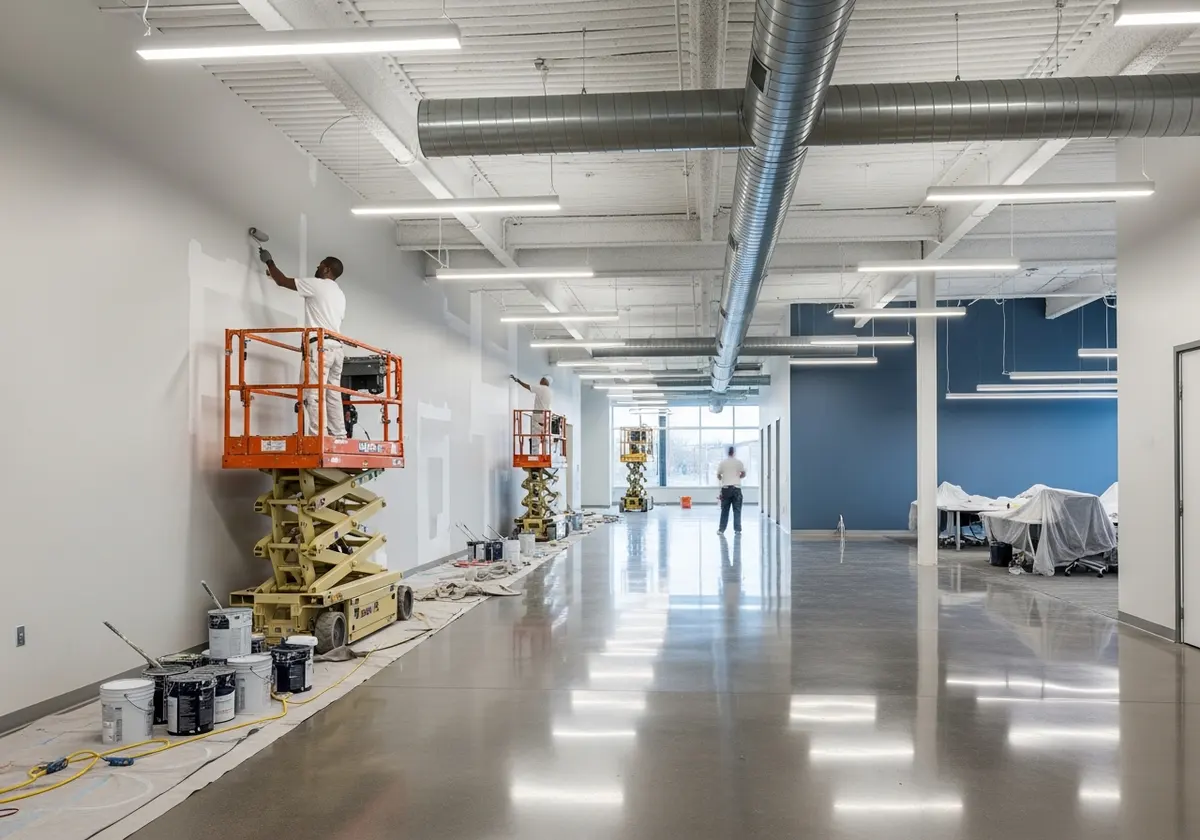
Commercial Painting
Offices, retail, and industrial spaces painted on schedule with minimal disruption.
Prepare your project brief
Build a clear scope to discuss with a contractor. Directory listings are being restored; this does not confirm local availability.